
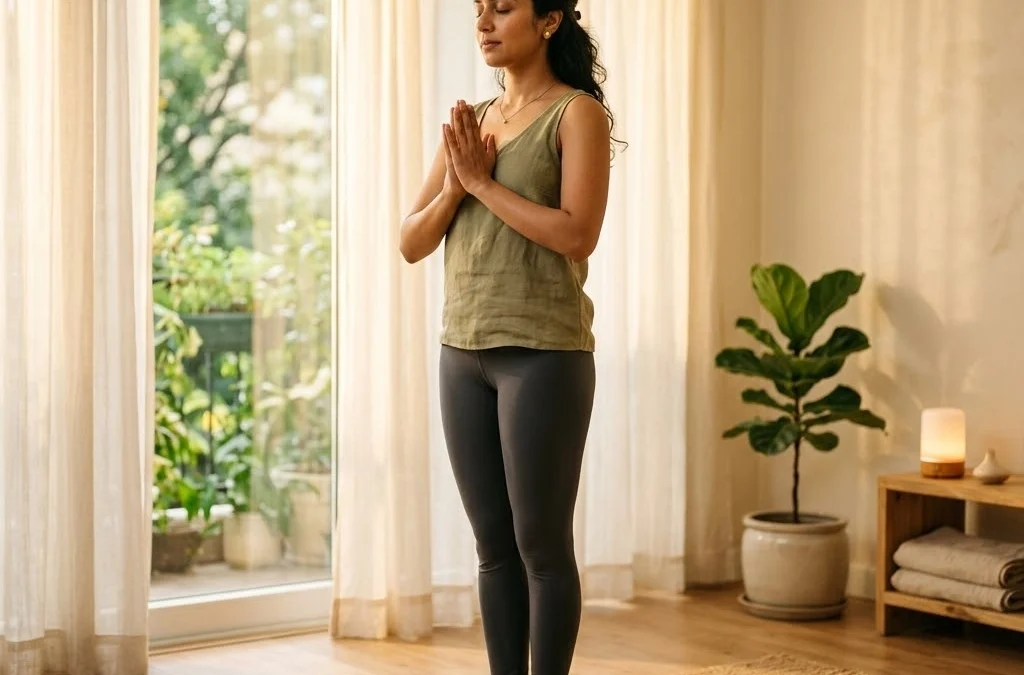
Twelve movements. One sequence. And if you practice it consistently, probably the most complete thing you can do for your body in fifteen minutes every morning.
Surya Namaskar has been part of yoga for centuries — and it’s stayed because it works. But here’s the thing nobody tells you when you start: watching someone flow through it and actually learning it properly are two completely different experiences. The alignment matters more than it looks. The breath timing matters more than most beginners expect. And when both are off, the sequence delivers maybe half of what it’s capable of.
This guide is for people who want to learn it well — not just copy the shape from a video and wonder why it never quite feels right.
What Is a Surya Namaskar Online Class?
It’s a live or guided session where an instructor takes you through all twelve steps — teaching you the correct alignment, the breath pattern, and how to build your practice progressively — from wherever you happen to be.
The difference between this and a YouTube video comes down to two things: feedback and structure. In a proper guided session, someone is watching how you move. They catch the things you can’t see yourself. And they build your practice in a sequence that makes sense — so you’re not just repeating the same round indefinitely without getting better.
Our Surya Namaskar programme works exactly this way — starting from the foundations and building toward a daily practice you can actually sustain.
Why Learn Online Instead of Figuring It Out Yourself?
Most people who try to learn from videos alone hit a wall at some point. The sequence looks right when they do it. It doesn’t feel right. And without anyone to tell them why, they just keep repeating it the same way.
Three things a guided class gives you that self-teaching genuinely can’t:
Alignment correction. Small misalignments in Downward Dog and Chaturanga feel fine in the moment. Over weeks and months, they show up as wrist pain, shoulder strain, or a nagging lower back issue. An instructor spots these things early — before they become problems.
Breath coordination. This is the part most beginners underestimate. Surya Namaskar is a breathing practice as much as a movement practice. Every single step connects to either an inhale or an exhale. When that connection is off, the sequence feels like hard work. When it’s right, the whole thing flows — almost effortlessly.
Progressive structure. A good programme doesn’t just hand you the sequence and leave you to it. It builds your capacity week by week. What you’re doing in round one of week one should look and feel different from round five of week three. A structured plan accounts for that progression deliberately.
What Consistent Daily Practice Actually Does
Surya Namaskar works the whole body in one sequence. Here’s what you actually get from practicing it regularly:
Physically:
- Full-body strength — arms, shoulders, core, legs, and back all engage in every round
- Improved spinal flexibility and mobility in both directions
- Better posture from the repeated combination of extension and flexion
- Genuine cardiovascular endurance when practiced at a moderate pace
- Lean muscle building that supports your metabolism across the day
Internally:
- Better digestion — the compression and release of abdominal organs in each round actively stimulates the digestive system
- More consistent energy, particularly noticeable when practiced in the morning
- A calmer nervous system from the rhythmic, consistent breath pattern
Mentally:
- Sharper focus — the breath-movement coordination demands present-moment attention in a way that naturally settles the mind
- Reduced anxiety over time, particularly with morning practice
- A reliable daily anchor that tends to stick in a way that other morning routines don’t
If weight loss is part of your goal, Surya Namaskar works particularly well alongside our weight loss yoga programme — the two complement each other naturally.
The 12 Steps — And the Breath That Goes With Each One
This is the part that separates people who feel the sequence from people who just go through it. Each step connects to a specific breath. Learning that connection is what makes everything click.
| Step | Pose | Breath |
| 1 | Prayer Pose — Pranamasana | Exhale |
| 2 | Raised Arms — Hasta Uttanasana | Inhale |
| 3 | Standing Forward Fold — Hasta Padasana | Exhale |
| 4 | Low Lunge — Ashwa Sanchalanasana | Inhale |
| 5 | Plank — Dandasana | Inhale |
| 6 | Eight-Limbed Pose — Ashtanga Namaskara | Exhale |
| 7 | Cobra — Bhujangasana | Inhale |
| 8 | Downward Dog — Adho Mukha Svanasana | Exhale |
| 9 | Low Lunge — Ashwa Sanchalanasana | Inhale |
| 10 | Standing Forward Fold — Hasta Padasana | Exhale |
| 11 | Raised Arms — Hasta Uttanasana | Inhale |
| 12 | Prayer Pose — Pranamasana | Exhale |
One thing that confuses almost every beginner: a complete round uses both sides of the body. The left leg leads in step four, and the right leg leads in step nine of the second half. Most people practice the first half, stop, and call it a round. It isn’t — it’s half a round. Both halves together make one.
Mistakes That Keep Beginners Stuck
Moving faster than the breath. This is the most common mistake, and it undermines the whole practice. When your movement overtakes your breath, you lose the nervous system benefit entirely. The rule is simple: the breath leads, the body follows. If you’re holding your breath in the harder transitions, the pace is too fast. Slow down.
Collapsing through Chaturanga. The transition from Plank to Eight-Limbed Pose is where most beginners compensate — either in the lower back or the elbows. If you can’t maintain the form, come to your knees first. That’s not a modification to be embarrassed about — it’s how you build the strength to do the full version properly.
Treating feet alignment as a small detail. In Forward Fold and Downward Dog, how your feet are placed changes everything. Hip-width apart, toes pointing forward, weight distributed evenly across the foot. It seems minor. It isn’t.
Practicing after eating. Surya Namaskar is traditionally practiced in the morning on an empty stomach. If you’re practicing at another time of day, wait at least two hours after a meal. The forward folds and prone poses need space internally to work properly.
How Many Rounds Is the Right Number?
There’s no universal answer — it depends on where you are and what you’re working toward.
| Goal | Rounds | What to Focus On |
| Complete beginner | 2–4 | Form and breath, not quantity |
| Building a daily habit | 6–8 | Consistency above all else |
| Weight loss support | 10–12 | Moderate pace, steady breath |
| Experienced practitioner | 12–108 | Traditional daily practice |
Start at two to four rounds and don’t rush past them. Adding rounds before your foundation is solid just means you’re practicing your mistakes more efficiently — which isn’t the goal.
A 21-Day Plan for Complete Beginners
Three weeks of the right progression takes most beginners from uncertain to confident. Here’s how to structure it:
Week 1 — Learn the sequence Two to three rounds daily. Move slowly — slowly enough that you can say the name of each pose as you enter it. This week is entirely about memorisation and breath awareness. Don’t try to make it look good yet.
Week 2 — Find the rhythm Four to six rounds. The goal now is smooth transitions — stopping between poses means you’re still thinking, not flowing. Notice where you hold your breath and consciously let it go. The breath is your pacer.
Week 3 — Build the habit Six to eight rounds daily. By now the sequence should feel familiar enough that you’re not thinking about what comes next. That’s when you can start paying attention to the quality of each individual pose — and that’s when real progress begins.
After 21 days, most beginners are ready to move toward ten to twelve rounds and start exploring what the practice can do at greater volume.
Who Is This Actually For?
Almost anyone — with sensible modifications where needed.
Complete beginners benefit most from guided learning precisely because they don’t yet have incorrect habits to unlearn. Starting right is always easier than correcting later.
Women managing PCOD or thyroid conditions find that consistent Surya Namaskar supports hormonal regulation and metabolism in ways that complement a targeted programme. Our PCOD yoga programme works well alongside it.
People focused on weight loss often use Surya Namaskar as the active foundation of their practice — it’s one of the most output-efficient sequences in yoga relative to the time it requires.
Busy professionals who want one complete practice that fits into fifteen to twenty minutes before the day starts. Twelve rounds at a moderate pace covers the whole body and leaves you clearer-headed than you started.
Older beginners and seniors can work with modified versions — slower pace, shallower pose depth, chair support — and still receive the cardiovascular and mobility benefits without the strain of a full expression.
Why Geetanjali Yoga’s Approach Is Different
There’s no shortage of Surya Namaskar content online. What’s harder to find is someone who understands the sequence deeply enough to teach it well — and who understands your body well enough to adapt it for you.
At Geetanjali Yoga, sessions start with a real conversation. Not a form — an actual discussion about your fitness level, any physical limitations, what you’ve tried before, and what you’re hoping the practice will do for you. From there, the programme is built around your specific situation.
Geetanjali has over 12 years of experience teaching across all body types and health backgrounds. She doesn’t just teach you the twelve steps — she teaches you to feel them correctly. That’s the thing that makes the practice stick rather than fade after a few weeks.
Explore the Surya Namaskar programme here — or start with a 7-day free trial and experience a guided session before you commit to anything.
FAQs
Can a complete beginner really learn this online?
Yes — and for many beginners, online is actually better than a studio group class. In a room of twelve people, an instructor can’t watch everyone at once. In a personalised online session, your alignment and breath get genuine attention throughout.
How long does it realistically take to learn it properly?
Most beginners can complete the full sequence with reasonable confidence within one to two weeks of daily practice. Learning it well — correct alignment, smooth transitions, breath fully coordinated — takes three to four weeks of consistent guided practice. The sequence is simple. The quality takes a little longer.
Is it safe during pregnancy?
In the first trimester, gentle modified versions may be practiced with guidance. From the second trimester onward, standard Surya Namaskar isn’t generally recommended because of the prone poses and abdominal compression involved. Our pregnancy yoga programme offers safe, trimester-specific alternatives throughout.
Does it actually help with weight loss?
It contributes meaningfully when practiced consistently. Ten to twelve rounds at a moderate pace elevates heart rate, builds lean muscle, and supports metabolic function. It works best as part of a broader practice rather than the only thing you’re doing — but as a foundation, it’s excellent.
What’s the best time of day to practice?
Traditionally, early morning on an empty stomach — facing east as the sun rises. Practically, the best time is whichever time you’ll actually do it consistently. Morning tends to feel more energising. Evening tends to feel more meditative. Both deliver the full benefit.