
You’re not imagining it.
The same effort that kept you lean at 25 is producing noticeably less at 35 — and no matter how many times you’ve told yourself to just try harder, try harder hasn’t worked. Because trying harder was never the problem.
Somewhere between managing a full-time job, running a household, and trying to stay healthy, fitness quietly becomes something you do out of guilt rather than something that genuinely makes you feel better. And the advice you’ve been following — more cardio, fewer calories, push through the fatigue — was written for a version of your body that existed ten years ago.
Here’s what nobody tells you clearly enough: after 30, your body has different needs. Not worse. Different ones. And once you understand what they are, the whole thing starts making a lot more sense.
What Actually Changes in Your Body After 30
There’s no dramatic moment where things shift. It’s gradual — which is exactly why it’s so frustrating to name.
The muscle you’re not thinking about
From your late twenties, the body starts losing a small amount of muscle mass every year. Not dramatically, not visibly — just slowly, quietly, without announcement. The reason this matters is that muscle is metabolically expensive. It burns energy even when you’re sitting still, even when you’re sleeping, even when you’re doing nothing at all.
Lose enough of it and the engine underneath your workouts slows down. The exact same cardio session you did at 26 burns meaningfully fewer calories at 36 — not because you’re working less hard, but because the body burning those calories has changed.
The cortisol problem nobody explains
Women in their thirties are managing a level of accumulated stress that most of us have simply normalised. Work pressure, domestic responsibility, the mental load of running everything — it’s enormous, and the body registers all of it through cortisol, the primary stress hormone.
Here’s the part that matters for exercise: intense cardio is a significant cortisol trigger. In a body with well-managed stress, that spike is temporary and the system recovers. In a body already running high on cortisol — which describes most women over 30 with demanding lives — that spike can persist. And chronically elevated cortisol is one of the most efficient signals your body has for storing fat, particularly around the belly. More intense cardio in this state doesn’t help. It usually makes things worse.
Recovery that takes longer than it used to
This is the one most people feel first, even if they don’t name it. Five sessions a week used to leave you feeling strong. Now it leaves you genuinely depleted, and the depletion takes days to clear rather than hours. That’s not weakness — it’s a real physiological shift that asks for a smarter approach, not a harder one.
Why Cardio Alone Stops Working
Let’s be clear about something before going further: cardio is not the enemy. It supports heart health, lifts mood, and burns calories during the session. If you enjoy it, it absolutely has a place.
The problem is when it’s the only approach — and particularly when the response to diminishing results is to add more of it.
More cardio doesn’t rebuild the muscle that’s quietly declining with age. Without that muscle, the resting metabolism continues to slow year on year. Burning more calories in a session doesn’t compensate for burning fewer every hour of every day. The maths stops working.
There’s also what happens to someone like Meera — exercising five days a week, cutting back on rice, drinking her water, doing everything right, and gaining two kilos over eight months. Not because she lacked discipline. Because the method was actively working against her biology. Five cardio sessions a week on a body already flooded with stress hormones kept her cortisol elevated, disrupted her sleep, increased her sugar cravings, and told her body to hold on tightly to every bit of fat it had.
The answer wasn’t more effort. It was a completely different approach.
What Functional Fitness Actually Is
Functional fitness is not a new trend someone invented at a boutique gym. It’s the way human bodies were designed to move before we started spending eight hours a day in chairs.
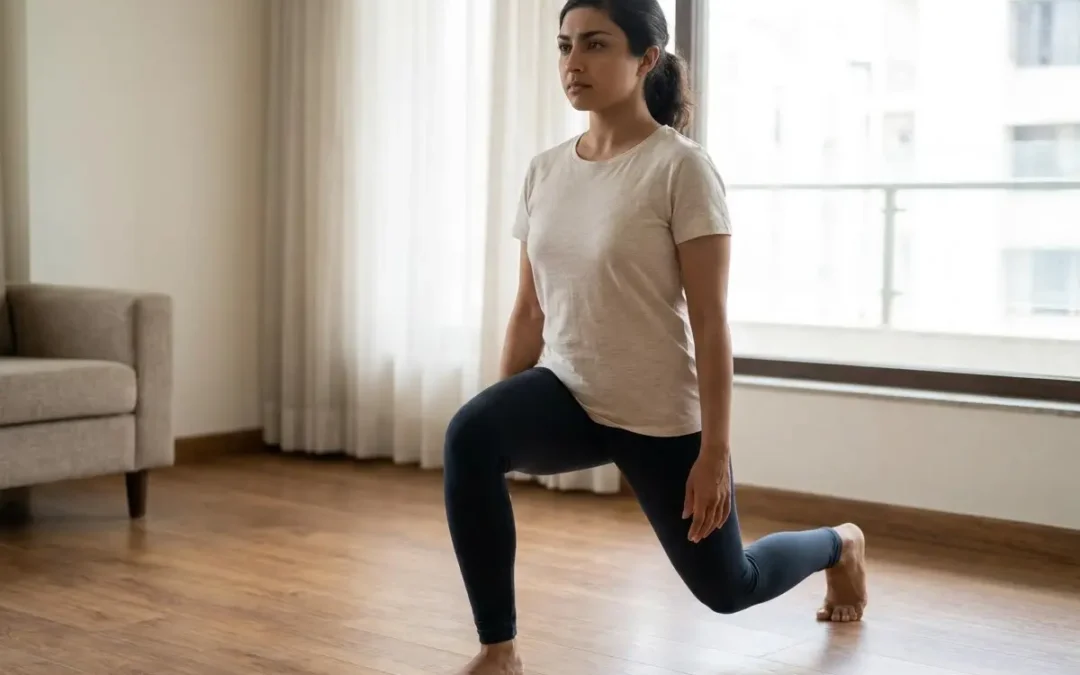
Squatting. Lunging. Pushing. Pulling. Hinging. Rotating. These are the patterns your body uses to get through an ordinary day — and training them builds lean muscle across multiple groups simultaneously, in the way they actually work together rather than in isolation.
It’s also genuinely hard. This isn’t a gentle alternative to real exercise for people who can’t manage real exercise. Done properly, functional training produces real strength gains, real changes in body composition, and an afterburn effect — elevated calorie burning for hours after the session ends — that cardio alone simply doesn’t create to the same degree.
And it doesn’t require a gym, a personal trainer, expensive equipment, or more than 35 minutes. A 6×6 foot space on your living room floor is completely sufficient.
What It Does That Cardio Can’t
It rebuilds the muscle you’ve been losing
This is the most important thing. More lean muscle means a higher resting metabolism — your body burns more calories while doing nothing, every hour, all day. This is the metabolic shift that makes fat loss sustainable after 30, and cardio doesn’t create it.
The calorie burning doesn’t stop when you do
Cardio burns during the session. Functional training creates what’s called excess post-exercise oxygen consumption — your body continues burning at an elevated rate for hours after you stop. For a woman whose resting metabolism has slowed, this difference adds up significantly over weeks and months.
It manages cortisol rather than spiking it
Because functional training works through strength and moderate intensity rather than sustained high intensity, it produces a far more manageable cortisol response. For women dealing with hormonal weight gain, PCOS concerns, or the metabolic shifts that come with perimenopause, this specific difference is often what changes everything.
It fixes what sitting does to your body
Eight hours at a desk shortens your hip flexors, weakens your glutes, rounds your upper back, and tightens your chest. Core and posture work is built into every functional session — which is why women who do this consistently report less lower back pain, less neck tension, and noticeably better posture within weeks, often before they notice any change on the scale.
Daily life becomes easier
Carrying shopping up the stairs. Picking something up from the floor without wincing. Sitting through a long meeting without your back starting to complain. These are the improvements that show up in real life — quiet, practical, significant.
What a Session Actually Looks Like at Home
No gym. No dumbbells. The floor and 35 minutes.
Warm-up — 5 minutes
Start with slow joint rotations from the neck down to the ankles. Hip circles. A few cat-cow movements for the spine. Nothing intense — just waking the joints up and letting the nervous system know something is about to happen.
Main session — 25 minutes
Three rounds of the following, with 60 seconds rest between each round:
- Bodyweight squats — 12 reps (quads, glutes, core)
- Push-ups or modified push-ups on the knees — 10 reps (chest, shoulders, triceps, core)
- Reverse lunges — 10 each side (glutes, hamstrings, balance)
- Plank hold — 30 seconds (deep core, shoulders, full body)
- Glute bridges — 15 reps (glutes, lower back, pelvic floor)
- Dead bug — 10 each side (deep core, coordination)
That’s every major muscle group, in patterns that mirror real daily movement, in 25 minutes.
Cool-down — 5 minutes
A seated forward fold, a spinal twist on each side, and child’s pose. Heart rate comes down, the recovery process begins, and your nervous system gets the signal that the work is done.
On alternating days, pairing this with weight loss yoga creates something neither practice achieves alone — functional training builds the physical strength, yoga manages the cortisol and nervous system regulation underneath. The combination is genuinely more effective than either individually.
Who This Is Actually For
You don’t need to tick every box. One is enough.
You’ve been exercising consistently and the results have quietly stalled. You carry weight around your middle that doesn’t shift regardless of what you do. Your workouts leave you tired rather than energised. You have background back or neck pain that stretching helps temporarily but never actually fixes. You want real strength without a gym membership. You’re managing PCOS, thyroid concerns, or perimenopause and the standard fitness advice simply doesn’t map to your actual situation.
Adding strength training alongside functional fitness builds an even stronger foundation for women in any of these categories — the muscular base that makes everything else more effective over time.
What to Do Next
The approach you’ve been using isn’t failing you because you lack something. It’s failing you because it wasn’t built for where your body is right now.
The functional fitness programme at Geetanjali Yoga is live, online, and built specifically around the hormonal and metabolic picture of women who’ve been doing the right things and not getting the right results. Real guidance, real form correction, real adaptation as you progress.
No gym required. No equipment required. Just a different method — one that was actually designed for you.
Start your 7-day free trial →
Explore the Functional Fitness programme →
Frequently Asked Questions
Q1. Can I do functional fitness at home without any equipment?
Yes — completely. Every movement in a functional fitness session uses your own bodyweight. Squats, lunges, push-ups, planks, glute bridges — all highly effective with zero equipment. A 6×6 foot space on your living room floor is genuinely all you need.
Q2. How is functional fitness different from the cardio I’m already doing?
Cardio burns calories during the session. Functional fitness builds lean muscle that burns calories all day — even at rest. It also manages cortisol rather than spiking it, which matters enormously for women over 30 with demanding, high-stress lives.
Q3. How soon will I notice a difference?
Most women notice less back pain, better posture, and improved energy within two to three weeks. Visible changes in body composition — leaner, stronger, less belly weight — typically follow at six to eight weeks with consistent practice three times weekly.
Q4. Is functional fitness safe if I have PCOS or a thyroid condition?
Yes — and often specifically recommended. Functional training improves insulin sensitivity, supports healthy cortisol regulation, and builds lean muscle that helps the metabolism function better. A personalised programme that accounts for your specific condition is always the right starting point.
Q5. How many days a week do I need to train?
Three sessions a week is enough to see real results. Consistency matters far more than frequency — three sessions every week for eight weeks will outperform six sessions one week and nothing the next, every single time.