Pay attention next time you’re stressed, and you’ll catch it — your breath changes before your mind has even caught up to what’s wrong. It gets short. Shallow. Climbs up into your chest. And your whole nervous system just follows along, usually a good few seconds before you’ve consciously registered anything’s off.
That’s not a throwaway observation. It’s basically the entire foundation pranayama is built on. Controlling your breath isn’t some mystical idea pulled from old yogic texts — it’s a genuine, physical lever you can pull on your own nervous system. Slow your breathing down on purpose, and the parasympathetic nervous system switches on. The vagus nerve gets stimulated, which is essentially your body’s built-in brake pedal for stress. Heart rate drops. Cortisol eases. The mental static that felt impossible to manage ten minutes ago starts quieting down without much effort.
Here’s where things usually go sideways, though. Breathwork looks deceptively easy from the outside, and it’s surprisingly simple to get wrong. Hold a breath too long, rush through a count that doesn’t actually match your lung capacity, slump through the whole thing with your shoulders up near your ears — and you end up lightheaded, or more wound up than when you sat down. This is pretty much the whole reason online pranayama classes have taken off the way they have. Someone’s actually watching your form, correcting your pace, fitting the routine around a schedule that’s real — not the version where you’ve magically got a spare hour every morning.
This guide gets into which platforms are actually worth your time, the core techniques specifically for stress and anxiety, and a five-minute routine you could start tonight if you wanted to.
Live vs. Self-Paced: Which Online Pranayama Classes Actually Fit You
Why structured guidance genuinely matters
Breath is more delicate than most people assume going in. Hold it too long, force an inhale that’s deeper than feels natural, sit through the whole session with bad posture — any of this can set off dizziness, neck tension, or a spike of anxiety instead of the calm you were chasing.
A video can show you what a technique looks like in theory. What it can’t do is notice your shoulders slowly creeping up toward your ears, or catch you straining to hit a count that was never realistic for where you’re starting. That gap is exactly what live instruction fills in.
What the different platform types are actually offering
Not every online pranayama class is trying to solve the same problem, so it’s worth figuring out which one you actually need:
| Format | Best for | Examples |
| Live, interactive group sessions | Daily accountability, real-time correction | Shvasa, Ekam Yoga |
| Structured certifications & deeper modules | Serious, long-term study | The Yoga Institute, Arhanta Yoga |
| Free, self-paced learning | Casual exploration, basics | Yoganama |
If you already know you’ll let a solo video slide without someone expecting you to turn up, go live — a scheduled class is a lot harder to skip than a saved link sitting forgotten in a folder. If you’re past the basics and actually want to understand the mechanics underneath the practice, certification-level courses go a lot deeper. Self-paced platforms are a decent entry point too, honestly, as long as you pair them with at least one live session early on, just to check your form hasn’t quietly drifted somewhere wrong.
If what you actually want is stress relief now, not a certificate down the line, a structured pranayama and meditation programme with real instructor access tends to get people breathing correctly far faster than cobbling it together from random videos ever manages to.
Stick with live guidance for the first few weeks at least, even if you eventually plan on going solo. Getting the foundation right matters more than which platform you end up settling into long-term.
Pranayama Techniques That Actually Help With Stress
Sama Vritti — Equal Breathing
This is usually the first technique people learn, and honestly, it deserves that spot. Inhale for a count of four, hold for four, exhale for four, hold for four. Most people just call it box breathing. It’s almost insultingly simple, and that simplicity is exactly why it works — it gives a racing mind a count to hold onto instead of something to spiral over.
Ujjayi — Ocean Breath
Breathe through your nose while gently constricting the back of your throat, and you get this soft, audible “ocean” sound on both the inhale and exhale. That sound becomes an anchor point. When stress has your attention jumping between a dozen half-finished thoughts, having one specific thing to actually listen to does more than you’d expect walking in.
A few practical notes worth knowing
- Five to ten minutes is genuinely plenty when you’re starting — there’s no need to stretch it out just because longer feels more productive
- Practice on an empty stomach, ideally a couple hours after you’ve eaten
- Morning practice tends to set the tone for your whole day; evening practice is better for actually winding down before bed
- Five focused minutes daily will outdo one exhausting half-hour session you only manage to pull off twice a month
For Anxiety Specifically: Resetting a Racing Nervous System
Nadi Shodhana (Alternate Nostril Breathing)
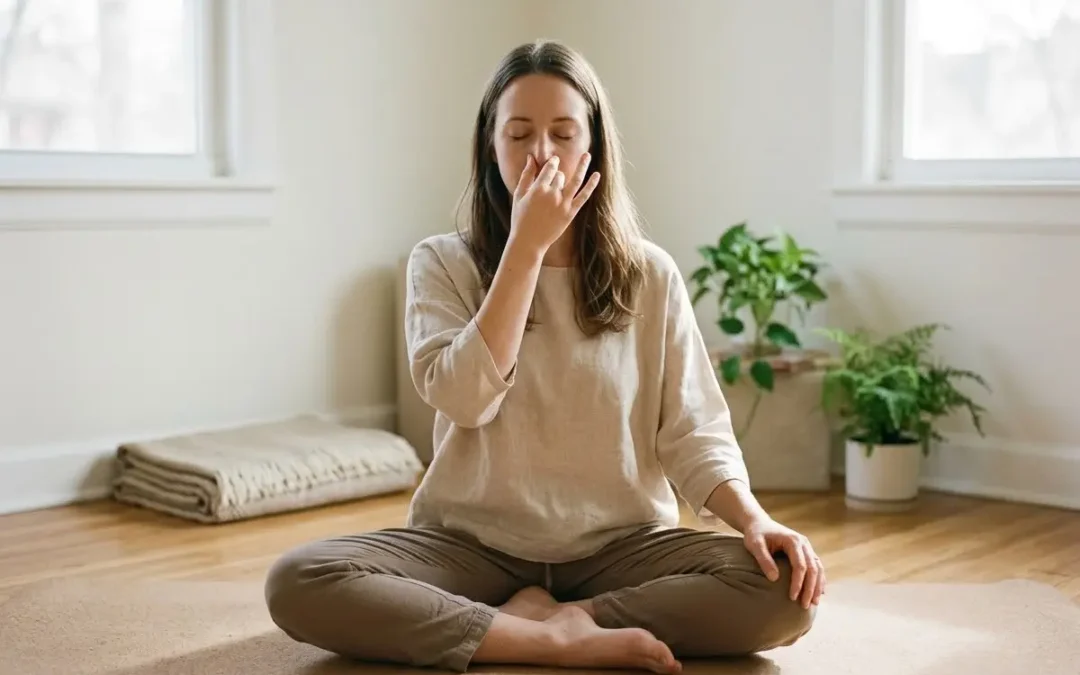
You breathe through one nostril at a time, alternating sides using your thumb and ring finger to gently close each in turn. This technique works particularly well for anxiety because it’s believed to balance activity across both hemispheres of the brain, and the slow, deliberate rhythm interrupts that loop where the same anxious thought keeps playing on repeat.
A reasonable starting ratio is 1:2 — inhale for four counts, exhale for eight. That longer exhale is doing most of the actual work here. It’s the specific signal telling your nervous system it’s safe to come down a notch.
Bhramari (Humming Bee Breath)
Close your eyes, gently plug your ears with your thumbs, and hum steadily on the exhale. The vibration from humming stimulates the vagus nerve directly, since it runs close to the ear canal — probably why this is one of the only techniques that works almost instantly. Keep it on hand specifically for moments of acute anxiety, not just your scheduled practice time.
Think of Bhramari as your “right now” tool — two minutes before a stressful meeting, or in the middle of a spiral — rather than something saved only for a formal session.
Building a 5-Minute Daily Routine You’ll Actually Keep Up
Getting your posture sorted first
Sit cross-legged on the floor, a cushion under your hips if your knees end up sitting higher than your hips, or sit in a chair with both feet flat on the ground. Spine long, shoulders dropped away from your ears, hands resting however feels natural.
The routine itself
- Minute one: Sit quietly, eyes closed, just watching your natural breath without trying to change it yet.
- Minutes two and three: Box breathing — four-count inhale, hold, exhale, hold.
- Minutes four and five: Switch over to alternate nostril breathing, keeping that 1:2 inhale-to-exhale ratio going.
- Final thirty seconds: Drop back to your natural breath and just notice how different your body feels now compared to when you sat down.
A few things worth being careful about
- If you feel lightheaded during a breath hold, stop right away — don’t push through it
- Skip vigorous techniques like Kapalabhati on a full stomach
- If you’re pregnant, or managing a heart or respiratory condition, check with your doctor first and only practice under guidance
- If alternate nostril breathing ever triggers panic instead of calm — it happens occasionally — that’s your cue to slow down, not push harder through it
Where This Actually Gets You
Consistent breathwork doesn’t just feel nice in the moment. Over the course of a few weeks, it measurably lowers cortisol and builds a kind of resilience that leaves you generally less reactive to stress — not just calmer during the five minutes you’re actually practicing.
You don’t need an hour, a retreat, or any special equipment. You need five honest minutes and someone correcting your form before a bad habit has the chance to set in. If you’re ready to actually get started, a structured pranayama and meditation programme gives you exactly that — live instruction, correct technique from your very first session, and a schedule that’s built around real life, not the fantasy version where you’ve got an extra hour hiding somewhere.
So — which one are you planning to try first? Box breathing, alternate nostril, or humming bee breath? Or are you still deciding between a live class and figuring this out solo?
Frequently Asked Questions
1. How long before pranayama actually reduces stress?
Plenty of people notice a difference within the very first session — slower heart rate, looser shoulders, a quieter mind. Lasting shifts in your baseline stress level usually take about 2 to 4 weeks of sticking with it daily.
2. Can pranayama take the place of therapy or medication for anxiety?
No. It’s a genuinely useful tool for managing everyday stress and anxious thoughts, but it’s not a substitute for professional mental health care when anxiety is clinically significant. The two complement each other well.
3. What’s the best time of day to practice?
Morning practice, on an empty stomach, tends to set a calmer tone for the rest of your day. Evening practice works well for winding down before sleep. Either works fine — consistency matters a lot more than timing.
4. Is alternate nostril breathing safe for someone just starting out?
Yes, with the right guidance. Start with shorter holds and a gentle ratio like 1:2 rather than jumping into long breath retention immediately. Ease off right away if you start feeling lightheaded.
5. Do online pranayama classes require any equipment?
Not really. A quiet space, a cushion or chair, and around 5 to 10 minutes is enough. Most online classes need nothing more than a device with video access.