
Nobody’s spine was built for eight hours of sitting. And yet here we all are — shoulders inching toward our ears, chin pushed forward to meet the screen, lower back slowly forgetting what it even feels like to hold us up properly.
Most of us notice the symptoms long before we understand what’s causing them. An ache between the shoulder blades that shows up right around 3pm, every day, like clockwork. A neck that actually cracks when you finally look up from the laptop. A lower back that complains the second you stand up after a two-hour meeting. None of this is bad luck. It’s what happens when the muscles meant to support your spine all day quietly stop doing their job, and your body starts compensating in ways it was never built to.
This is where online core and posture training actually earns its place. You don’t need a gym membership, and you definitely don’t need an extra hour you don’t have. What you need is the right exercises, done regularly, with someone who can tell you honestly whether your form is helping or making things worse without you realizing it. This guide covers the specific beginner moves that target tech neck and lower back stiffness, how to pick between live classes and self-paced apps, and a 10-minute routine you could genuinely start today.
The Core-Posture Connection
Why your core is basically a spinal brace
Forget the six-pack image for a second. Your core is more like a natural corset wrapped around your spine — deep abdominal muscles, the muscles running along your lower back, your glutes, even your diaphragm, all working together to keep your spine stable no matter what you’re doing. When that system’s working well, your spine barely has to think about holding you upright. When it’s weak, which happens fast once you’re sitting most of the day, your spine starts leaning on momentum and bad habits instead — and that’s exactly where the slouching, the forward head, the constant low-grade tension all come from.
Why beginners shouldn’t start hard
If you’ve been fairly sedentary for a while, diving straight into an intense core routine usually backfires. You either strain something or get so sore you quietly give up within a week. The exercises that actually fix posture long-term tend to be low-impact and need zero equipment to start — they’re built around control and alignment, not intensity. That’s a genuinely different goal from chasing visible abs, and it helps to keep that distinction clear before you begin.
If your real goal is fixing posture and cutting down pain, skip the high-intensity core circuits for now. Control wins here, every time, over raw effort.
Top Core Strengthening Exercises for Beginners
Neck & upper back realignment
Chin tucks — Sit or stand tall, then gently pull your chin straight back, like you’re making a double chin, without tilting your head up or down. This one directly fights forward-head posture, which is probably the single most common issue anyone glued to a screen all day ends up with.
Wall angels & Y-W raises — Back against a wall, arms bent at 90 degrees and pressed into it, then slide them up and down like a snow angel. This opens up a tight chest and wakes up mid-back muscles that tend to go dormant after hours of rounded shoulders.
Deep core & spinal stabilization
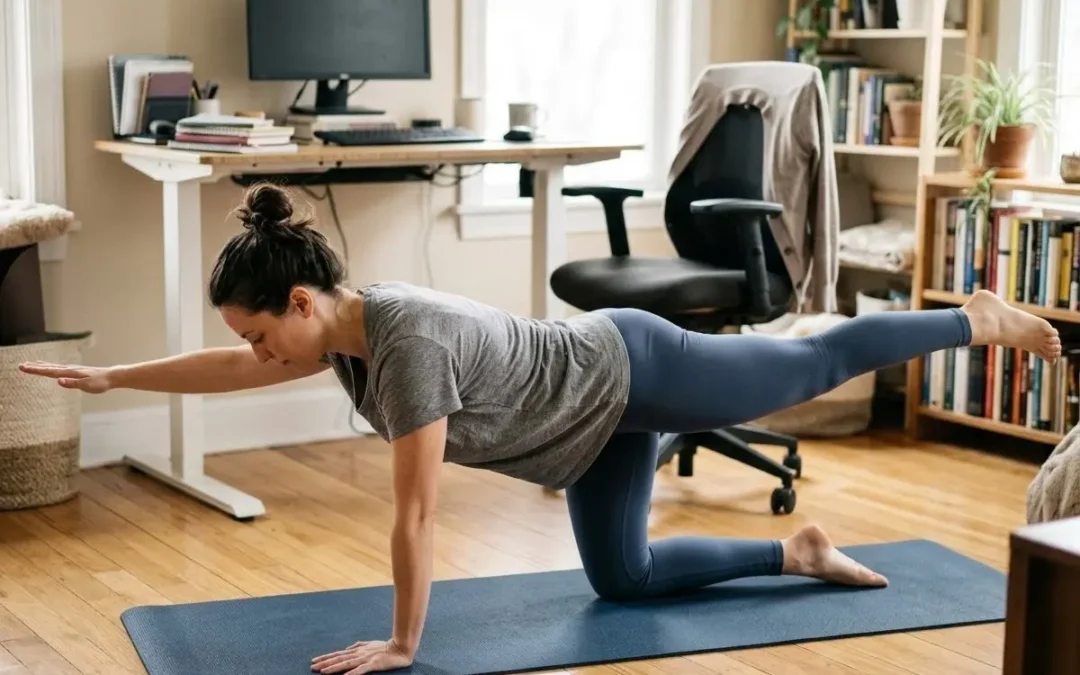
Bird-dog — On hands and knees, extend one arm forward and the opposite leg back, keeping your spine completely still the whole time. Builds balance, and teaches your core to actually stabilize your spine the way it’s supposed to during ordinary movement.
Dead bug — Lying on your back, arms reaching up, knees bent at 90 degrees, slowly lower one arm and the opposite leg toward the floor without letting your lower back lift off the ground. Sounds easy. Isn’t. It’s genuinely one of the better exercises out there for protecting the lower back specifically.
Glute bridge — On your back, knees bent, lift your hips until your body forms a straight line from shoulders to knees. Strengthens glutes that have basically gone to sleep from sitting all day, and directly supports pelvic alignment.
Modified plank — Forearms and knees instead of toes, holding a straight line from head to knees. Builds core endurance without putting the strain on an untrained lower back that a full plank often does.
Finding the Right Online Format
Live interactive classes
Joining online core and posture fitness classes for beginners — through something like Geetanjali Yoga or cult.fit — gets you real-time form correction, and honestly, that matters more here than in most other types of exercise. A dead bug done with an arched lower back isn’t just slightly less effective. It can actually make the pain you’re trying to fix worse. Having someone watching and correcting you in the moment is the fastest way to avoid that trap entirely.
Self-paced videos & apps
Guided YouTube tutorials or app-based four-week posture plans (Udemy, Perfect Posture) work reasonably well if your schedule genuinely can’t accommodate fixed class times. The obvious tradeoff: nobody’s watching your form. It’s worth filming yourself occasionally and comparing against the instructor’s positioning, or at least starting with one live session before going fully solo.
| Format | Best for | Examples |
| Live interactive classes | Real-time form correction, accountability | Geetanjali Yoga, cult.fit |
| Self-paced apps & videos | Flexible scheduling, casual starting point | Udemy, Perfect Posture, YouTube |
Daily 10-Minute Posture Reset Routine
The sequence
- Chin tucks — 2 sets of 10, holding each for 3 seconds
- Cat-cow — 10 slow rounds, moving with your breath
- Bird-dog — 8 reps each side, holding 3 seconds at full extension
- Glute bridge — 12 reps, pausing at the top
A few things worth knowing
- Breathe naturally through all of this — holding your breath just adds tension through the neck and shoulders you don’t need
- Consistency beats intensity, pretty much every time. Ten honest minutes a day will outperform one exhausting 45-minute session you only manage once a week
- Fix your actual workspace too — monitor at eye level, feet flat, lower back supported — otherwise you’re undoing ten minutes of good work the moment you sit back down
Daily spinal alignment work isn’t some quick fix. It’s what prevents the chronic neck and back pain that builds up slowly, quietly, one unnoticed slouch at a time, over years of sitting. Ten minutes a day, done with decent form, genuinely adds up more than people expect.
If you’re tired of guessing whether your form is actually right, a structured core and posture programme gives you real correction from the start, built around a schedule that actually fits a desk job — not the fantasy version where you’ve got a spare hour lying around.
What’s bothering you most right now — neck stiffness, lower back pain, or just general slouching? That’s usually the best place to start fixing things.
Frequently Asked Questions
1. How long does it take to fix posture with core training?
Most people notice less stiffness and better awareness of their posture within 2 to 3 weeks of sticking with it daily. Actual visible changes in alignment usually show up around 6 to 8 weeks in.
2. Can core and posture training help with tech neck specifically?
Yes. Chin tucks and wall angels go straight after forward-head posture, which is the main driver behind tech neck. Done consistently, they retrain the muscles that pull your head back where it belongs.
3. Do I need any equipment to start?
Nope. Chin tucks, bird-dog, glute bridges, modified planks — all of it just needs your bodyweight and a mat or a reasonably soft floor.
4. Is it safe to do these exercises with existing back pain?
Generally, yes — they’re low-impact and built to stabilize rather than strain the spine. That said, if you’ve got a diagnosed back condition, check with a doctor or physio first, and lean toward a guided class so your form gets checked properly.
5. How is this different from a regular ab workout?
A typical ab workout chases visible muscle and intensity. Core and posture training is after something different entirely — deep stabilizing muscles and spinal alignment, with pain reduction and better posture as the actual goal, not aesthetics.